The most successful piece of furniture ever made
Cast your mind back to 2020. Lockdown had shoved everyone in front of a webcam, and we all became unwitting voyeurs of each other's rooms – millionaire actors chatting to Graham Norton, politicians broadcasting from spare bedrooms, theatre companies stitching together productions over Zoom, journalists interviewing strangers. Once you started noticing, the same bookcase kept appearing in the background. Whoever they were, wherever they lived, the same plain, blocky, slightly-overstuffed shelves often stood quietly behind them.
It was the IKEA Billy. And you probably own one.
There aren't many objects that belong in both a broke student's room and a French château, but the Billy bookcase manages both with ease. Aggressively ordinary and quietly ubiquitous, it has become an icon of simplicity and distribution.
Created in 1979, IKEA has sold more than 140 million of them – one rolls off the line every three seconds. Bloomberg has even used it as an economic indicator, comparing Billy's price across countries the way The Economist compares Big Macs. It may well be the most successful piece of furniture ever made.
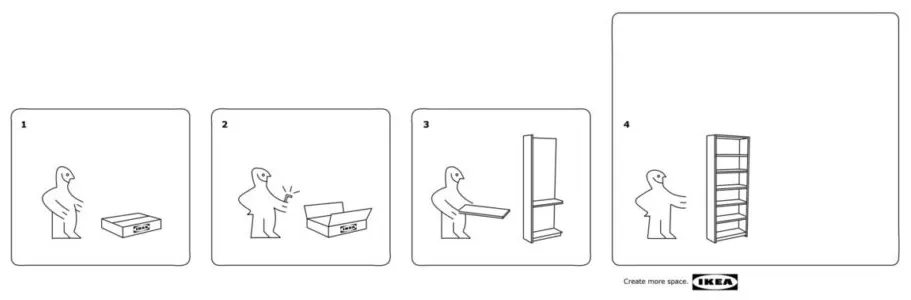
The origin story contains a napkin sketch, Romanian factory floors, and a man called Billy who kept pestering the company for a proper bookcase. The details are a little messy, but the result isn't. IKEA made a shelf that was easy to ship, easy to assemble, easy to combine, and cheap enough for millions of people to buy.
The Billy isn't innovative the way an iPhone is innovative; it's innovative the way container shipping is innovative – relentlessly, boringly, world-changingly efficient.
The standard Billy measures 80 × 28 × 202 cm, though it was originally 90 cm wide. In 1988 IKEA shrank it to 80 cm because customers complained that wider shelves sagged under the weight of books – and, conveniently, because the new dimension fit perfectly onto their transport pallets. The 28 cm depth comfortably accommodates everything from paperbacks to deeper hardbacks.
Most cheap furniture looks cheap, and most expensive furniture demands admiration. Billy slips quietly between those two worlds: it just looks fine. That sounds like faint praise, but it isn't – looking fine in almost any room is a surprisingly rare skill.
Products usually succeed by standing out, but Billy succeeded by disappearing. It doesn't clash with anything because it doesn't say anything; it's a blank canvas onto which you project your own taste, which is why it works equally well in a Scandinavian flat, a Manhattan studio, or a Lagos living room.
It has also spawned one of the most prolific DIY communities online, with people turning it into faux built-ins, pantry shelves, media walls, dollhouses, and display cabinets. The internet overflows with Billy transformations because the thing is so easy to repurpose – nobody treats it as a sacred object; they treat it as raw material.
Because of all this, Billy has escaped furniture and entered culture. The BBC included it in its "50 Things That Made the Modern Economy" series, and London's Museum of the Home now keeps one in its permanent collection as "a symbol of our modern age".
Billy didn't conquer the world through glamour, beauty, or status, but through usefulness, neutrality, and sheer scale. IKEA made a shelf plain enough for almost anyone to accept, cheap enough for almost anyone to buy, and flexible enough to fit almost any life.